|
"Behavioral Psychology"
|
Kenneth
R. Murray
Armiger Police Training Institute
|
Lt.
Col. Dave Grossman
Arkansas State University
|
Robert
W. Kentridge
University of Durham, U.K.
|
Academic
Press, 2000
Behavioral
psychology is the subset of psychology that focuses on studying
and modifying observable behavior by means of systematic
manipulation of environmental factors. This article examines
the history and origins of behavioral psychology, the role
of behavioral psychology in creating a revolution in military
training and combat effectiveness during the second half
of the 20th Century, and the contributions of behavioral
psychology in helping to understand one of the key causal
factors in modern violent crime.
Introduction:
A Behavioral Revolution in Combat
Behavioral
psychology, with its subsets of behavior modification and
operant conditioning, is a field that's ripe for use and
abuse in the realm of violence, peace and conflict. Perhaps
the least subtle or most "directive" of all the fields of
psychology, in its purest form behaviorism rejects all cognitive
explanations of behavior and focuses on studying and modifying
observable behavior by means of systematic manipulation
of environmental factors. In its application, behavior modification
and other aspects of the behavioristic approach are generally
considered best for use on animals and children (who tend
not to resent or rebel against such overt manipulation as
reinforcers and token economies), and for the preparation
of individuals to react immediately and reflexively in life
threatening situations such as: children in fire drills,
pilots repetitively trained to react to emergencies in flight
simulators, and law enforcement and military personnel conditioned
to fire accurately in combat situations.
Throughout
history armies and nations have attempted to achieve ever
higher degrees of control over their soldiers, and reinforcement
and punishment have always been manipulated to do so. But
it was done by intuition, half blindly and unsystematically,
and was never truly understood. In the 20th century this
changed completely as the systematic development of the
scientific field of behavioral psychology made possible
one of the greatest revolutions in the history of human
combat, enabling firing rates to be raised from a baseline
of 20% or less in World War II to over 90% among modern,
properly conditioned armies.
In the post-Cold War era the police officers and the soldiers
of the world's democracies are assuming increasingly similar
missions. Around the world armies are being called upon
for "peace making" and "peacekeeping" duties, and law enforcement
agencies are responding to escalating violent crime with
structures, tactics, training and weapons that have been
traditionally associated with the military. Some have observed
that this process may be resulting in the creation of a
new warrior-protector class similar to that called for by
Plato in that first, fledgling Greek democracy more than
2000 year ago. If there is a new class of warrior-protector,
then one factor which is profoundly unique in its modern
makeup is this systematic application of behavioral psychology,
particularly operant conditioning, in order to ensure the
warrior's ability to kill, survive, and succeed in the realm
of close combat.
Today the behavioral genie is out of the bottle and in life-and-death
close-combat situations any soldier or police officer who
is not mentally armed may well be as impotent as if he or
she were not physically armed. Governments have come to
understand this, and today any warrior that a democratic
society deems worthy of being physically armed is also,
increasingly, being mentally equipped to kill.
When
this is done with law enforcement and military professionals
it is done carefully and with powerful safeguards, yet still
it is a legitimate cause for concern. But the final lesson
to be learned in an examination of the role of behavioral
psychology in violence, peace, and conflict is that the
processes being carefully manipulated to enable violence
in government agencies can also be found in media violence
and violent video games, resulting in the indiscriminate
mass conditioning of children to kill, and a subsequent,
worldwide explosion of violence.
The
Birth of Behavioral Psychology
Around
the turn of the century, Edward Thorndike attempted to develop
an objective experimental method for testing the mechanical
problem solving ability of cats and dogs. Thorndike devised
a number of wooden crates which required various combinations
of latches, levers, strings, and treadles to open them.
A dog or a cat would be put in one of these puzzle boxes
and, sooner or later, would manage to escape.
Thorndike's initial aim was to show that the anecdotal achievement
of cats and dogs could be replicated in controlled, standardized
circumstances. However, he soon realized that he could now
measure animal intelligence using this equipment. His method
was to set an animal the same task repeatedly, each time
measuring the time it took to solve it. Thorndike could
then compare these learning curves across different situations
and species.
Thorndike was particularly interested in discovering whether
his animals could learn their tasks through imitation or
observation. He compared the learning curves of cats who
had been given the opportunity to observe other cats escape
from a box, with those who had never seen the puzzle being
solved, and found no difference in their rate of learning.
He obtained the same null result with dogs and, even when
he showed the animals the methods of opening a box by placing
their paws on the appropriate levers and so on, he found
no improvement. He fell back on a much simpler, "trial and
error" explanation of learning. Occasionally, quite by chance,
an animal performs an action that frees it from the box.
When the animal finds itself in the same position again,
it is more likely to perform the same action again. The
reward of being freed from the box somehow strengthens an
association between a stimulus (being in a certain position
in the box) and an appropriate action. Rewards act to strengthen
these stimulus-response associations. The animal learned
to solve the puzzle-box not by reflecting on possible actions
and really puzzling its way out of it but by a mechanical
development of actions originally made by chance. Thus,
Thorndike demonstrates that the mind of a dog or a cat is
not capable of learning by observation then can only learn
what has been personally experienced and reinforced.
By 1910 Thorndike had formalized this notion into the "Law
of Effect," which essentially states that responses that
are accompanied or followed by satisfaction (i.e., a reward,
or what was later to be termed a reinforcement) will be
more likely to reoccur, and those which are accompanied
by discomfort (i.e., a punishment) will be less likely to
reoccur. Thorndike extrapolated his finding to humans and
subsequently maintained that, in combination with the Law
of Exercise (which states that associations are strengthened
by use and weakened by disuse) and the concept of instinct,
the Law of Effect could explain all of human behavior in
terms of the development of a myriad of stimulus-response
associations.
Thorndike,
his laws, and trial-and-error learning became the foundation
for behavioral psychology, and the behaviorist position
that human behavior could be explained entirely in terms
of stimulus-response associations and the effects of reinforcers
upon them. In its purest sense this new field of behavioral
psychology entirely excluded cognitive concepts such as
desires or goals.
John Broadhus Watson in his 1914 book, Behavior: An Introduction
to Comparative Psychology, made the next major step in the
development of behavioral psychology. Watson's theoretical
position was even more extreme than Thorndike's. His rejection
of cognition, or "mentalism," was total and he had no place
for concepts such as pleasure or distress in his explanations
of behavior. He essentially rejected the Law of Effect,
denying that pleasure or discomfort caused stimulus-response
associations to be learned. For Watson, all that was important
was the frequency of occurrence of stimulus-response pairings.
Reinforcers might cause some responses to occur more often
in the presence of particular stimuli, but they did not
act directly to cause their learning. In 1919 Watson published
his second book, Psychology from the Standpoint of a Behaviorist,
which established him as the founder of the American school
of behaviorism.
In the 1920s behaviorism began to wane in popularity. A
number of studies, particularly those with primates (which
are capable of observational, monkey-see, monkey-do, learning),
appeared to show flaws in the Law of Effect and to require
mental representations in their explanation. But in 1938
Burrhus Friederich Skinner powerfully defended and advanced
behaviorism when he published The Behavior of Organisms,
which was arguably the most influential work on animal behavior
of the century. B.F. Skinner resurrected the Law of Effect
in more starkly behavioral terms and developed the Skinner
Box, a technology that allowed sequences of behavior produced
over a long time to be studied objectively, which was a
great improvement on the individual learning trials of Watson
and Thorndike.
Skinner developed the basic concept of "operant conditioning",
which claimed that this type of learning was not the result
of stimulus-response learning. For Skinner, the basic association
in operant conditioning was between the operant response
and the reinforcer, with a discriminative stimulus serving
to signal when the association would be acted upon.
It
is worth briefly comparing trial-and-error learning with
classical conditioning. In in 1890s, Pavlov, a Russian physiologist,
was observing the production of saliva by dogs as they were
fed. He noticed that saliva was also produced when the person
who fed them appeared, even though he was without food.
This is not surprising. Every farm boy for thousands of
years has realized that animals become excited when they
hear the sounds that indicate they are about to be fed.
But Pavlov carefully observed and measured one small part
of the process. He paired a sound, a tone, with feeding
his dogs so that the tone occurred several times right before
and during the feeding. Soon the dogs salivated to the tone,
as they did to the food. They had learned a new connection:
tone with food or tone with saliva response.
In classical conditioning, a neutral stimulus becomes associated
with an involuntary response, such as salivation or increased
heart rate. But operant conditioning involves voluntary
actions (such as lifting a latch, following a maze, or aiming
and firing a weapon) with reinforcing or punishing events
serving to alter the strength of association between the
stimulus and the response.
The ability of behavioral psychology to turn voluntary motor
responses into a conditioned response is demonstrated in
one of Watson's early experiments which studied maze-learning,
using rats in a type of maze that was simply a long, straight
alley with food at the end. Watson found that once the animal
was well trained at running this maze it did so almost automatically,
or reflexively. Once started by the stimulus of the maze
its behavior becomes a series of voluntary motor responses
largely detached from stimuli in the outside world. This
was made clear when Watson shortened the alleyway, which
caused well trained (i.e., conditioned) rats to run straight
into the end of the wall. This was known as the Kerplunk
Experiment and it demonstrates the degree to which a set
of behaviorally conditioned, voluntary motor responses can
become reflexive, or automatic in nature. Only a few decades
after Watson ran these early, simple experiments, the world
would see the tenets of behaviorism used to instill the
voluntary motor responses necessary to turn close combat
killing into a reflexive and automatic response.
The
Problem: A Resistance to Killing
Much
of human behavior is irrefutably linked to a mixture of
operant and classical conditioning. From one perspective
grades in school and wages at work are nothing more than
positive reinforcers, and grades and money are nothing more
than tokens in a token economy, and the utility of behaviorism
in understanding daily human behavior is significant.
Yet
the purist position (which holds that behavioristic processes
explain all aspects of human behavior), is generally considered
to be flawed in its application to humans, since humans
are able to learn by observational learning, and humans
tend to strongly oppose and negate blatant attempts to manipulate
them against their will. But in emergency situations, or
in the preparation of individuals for emergency situations,
behaviorism reigns supreme.
Those
in power have always attempted to utilize the basic behavioral
concepts of rewards, punishments, and repetitive training
to shape or control, and in many cases they would hope,
predict the responses of military and law enforcement personnel
throughout history. Certainly in ancient times when there
was no formal understanding of the underlying precepts of
conditioning, military leaders nevertheless subjected their
troops to forms of conditioning with the intention of instilling
warlike responses.
Repetition played heavily in attempting to condition firing
as seen in Prussian and Napoleonic drill in the loading
and firing of muskets. Through thousands of repetitions
it was hoped that, under the stress of battle, men would
simply fall back on the learned skill to continue firing
at the enemy. While this may have accounted for some increase
in the firing of muskets in the general direction of the
enemy, statistics from the Napoleonic era do not bear out
the hit ratios that would indicate success in the method,
success being determined by increased kill ratios.
In tests during this era it was repeatedly demonstrated
that an average of regiment of 250 men, each firing a musket
at a rate of four shots per minute, could hypothetically
put close to 1000 holes in a 6-foot-high by 100-foot-wide
sheet of paper at a range of 25 yards. But Paddy Griffith
has documented in his studies of actual Napoleonic and American
Civil War battles that in many cases the actual hit ratios
were as low as zero hits, with an average being approximately
one or two hits, per minute, per regiment, which is less
than 1% of their theoretical killing potential. While these
soldiers may have been trained to fire their weapons, they
had not been conditioned to kill their enemy.
In
behavioral terms, to prepare (or train, or condition) a
soldier to kill, the stimulus (which did not appear in their
training) should have been an enemy soldier in their sights.
The target behavior (which they did not practice for) should
have been to accurately fire their weapons at another human
being. There should have been immediate feedback when they
hit a target, and there should have been rewards for performing
these specific functions, or punishment for failing to do
so. No aspect of this occurred in their training, and it
was inevitable that such training would fail.
To truly understand the necessity for operant conditioning
in this situation it must first be recognized that most
participants in close-combat are literally "frightened out
of their wits." Once the arrows or bullets start flying,
combatants stop thinking with the forebrain (which is the
part of the brain that makes us human) and thought processes
localize in the midbrain, or mammalian brain, which is the
primitive part of the brain that is generally indistinguishable
from that of a dog or a rat. And in the mind of a dog the
only thing which will influence behavior is operant conditioning.
In
conflict situations the dominance of midbrain processing
can be observed in the existence of a powerful resistance
to killing one's own kind, a resistance that exists in every
healthy member of every species. Konrad Lorenz, in his definitive
book, On Aggression, notes that it is rare for animals of
the same species to fight to the death. In their territorial
and mating battles animals with horns will butt their heads
together in a relatively harmless fashion, but against any
other species they will go to the side and attempt to gut
and gore. Similarly, piranha will fight one another with
raps of their tails but they will turn their teeth on anything
and everything else, and rattlesnakes will wrestle each
other but they have no hesitation to turn their fangs on
anything else. Lorenz suggests that this non-species tendency
is innately imprinted into the genetic code in order to
safeguard the survival of the species.
One major modern revelation in the field of military psychology
is the observation that this resistance to killing one's
own species is also a key factor in human combat. Brigadier
General S.L.A. Marshall first observed this during his work
as the Chief Historian of the European Theater of Operations
in World War II. Based on his innovative new technique of
post-combat interviews, Marshall concluded in his landmark
book, Men Against Fire, that only 15 to 20% of the individual
riflemen in World War II fired their weapons at an exposed
enemy soldier.
Marshall's findings have been somewhat controversial, but
every available, parallel, scholarly study has validated
his basic findings. Ardant du Picq's surveys of French officers
in the 1860s and his observations on ancient battles, Keegan
and Holmes' numerous accounts of ineffectual firing throughout
history, Paddy Griffith's data on the extraordinarily low
killing rate among Napoleonic and American Civil War regiments,
Stouffer's extensive World War II and post-war research,
Richard Holmes' assessment of Argentine firing rates in
the Falklands War, the British Army's laser reenactments
of historical battles, the FBI's studies of nonfiring rates
among low enforcement officers in the 1950s and 1960s, and
countless other individual and anecdotal observations, all
confirm Marshall's fundamental conclusion that man is not,
by nature, a close-range, interpersonal killer.
The
existence of this resistance can be observed in its marked
absence in sociopaths who, by definition, feel no empathy
or remorse for their fellow human beings. Pit bull dogs
have been selectively bred for sociopathy, bred for the
absence of the resistance to killing one's kind in order
to ensure that they will perform the unnatural act of killing
another dog in battle. Breeding to overcome this limitation
in humans is impractical, but humans are very adept at finding
mechanical means to overcome natural limitations. Humans
were born without the ability to fly, so we found mechanisms
that overcame this limitation and enabled flight. Humans
also were born without the ability to kill our fellow humans,
and so, throughout history, we have devoted great effort
to finding a way to overcome this resistance.
The
Behavioral Solution: Conditioning to Kill
By
1946 the U.S. Army had completely accepted Marshall's World
War II findings of a 15 to 20% firing rate among American
riflemen, and the Human Resources Research Office of the
US Army subsequently pioneered a revolution in combat training
that replaced the old method of firing at bull's-eye targets
with deeply ingrained operant conditioning using realistic,
man-shaped pop-up targets that fall when hit.
The discriminative stimulus was a realistic target popping
up in the soldier's field of view. For decades this target
was a two-dimensional silhouette, but in recent years both
the military and police forces have been changing to mannequin-like,
three-dimensional, molded plastic targets; photo realistic
targets; and actual force-on-force encounters against live
adversaries utilizing the paint pellet projectile training
systems pioneered by The Armiger Corporation under the name
of Simunition. These are key refinements in the effectiveness
of the conditioning process, since it is crucial that the
discriminative stimulus used in training be as realistic
as possible in its simulation of the actual, anticipated
stimulus if the training is to be transferred to reality
in a crucial, life-and-death situation.
The
operant response being conditioned is to accurately fire
a weapon at a human being, or at least a realistic simulation
of one. The firer and the grader know if the firing is accurate,
since the target drops when hit. This realistically simulates
what will happen in combat, and it is gratifying and rewarding
to the firer. This minimal gap between the performance (hitting
the target) and the initial reinforcement (target drops)
is key to successful conditioning since it provides immediate
association between the two events. A form of token economy
is established as an accumulation of small achievements
(hits) are cashed in for marksmanship badges and other associated
rewards (such as a three-day pass), and punishments (such
as having to retrain on a Saturday that would have otherwise
been a day off) are presented to those who fail to perform.
The
training process involves hundreds of repetitions of this
action, and ultimately the subject becomes like Watson's
rats in the Kerplunk Experiment, performing a complex set
of voluntary motor actions until they become automatic or
reflexive in nature. Psychologists know that this kind of
powerful "operant conditioning is the only technique that
will reliably influence the primitive, midbrain processing
of a frightened human being, just as fire drills condition
terrified school children to respond properly during a fire,
and repetitious, stimulus-response conditioning in flight
simulators enables frightened pilots to respond reflexively
to emergency situations.
Modern marksmanship training is such an excellent example
of behaviorism that it has been used for years in the introductory
psychology course taught to all cadets at the US Military
Academy at West Point as a classic example of operant conditioning.
In the 1980s, during a visit to West Point, B.F. Skinner
identified modern military marksmanship training as a near-perfect
application of operant conditioning.
Throughout history various factors have been manipulated
to enable and force combatants to kill, but the introduction
of conditioning in modern training was a true revolution.
The application and perfection of these basic conditioning
techniques appear to have increased the rate of fire from
near 20% in World War II to approximately 55% in Korea and
around 95% in Vietnam. Similar high rates of fire resulting
from modern conditioning techniques can be seen in FBI data
on law enforcement firing rates since the nationwide introduction
of modern conditioning techniques in the last 1960s.
One of the most dramatic examples of the value and power
of this modern, psychological revolution in training can
be seen in Richard Holmes' observations of the 1982 Falklands
War. The superbly trained (i.e., conditioned) British forces
were without air or artillery superiority and were consistently
outnumbered three-to-one while attacking the poorly trained
(i.e. nonconditioned) but well equipped and carefully dug-in
Argentine defenders. Superior British firing rates (which
Holmes estimates to be well over 90%) resulting from modern
training techniques has been credited as a key factor in
the series of British victories in that brief but bloody
war. Today nearly all first-world nations and their law
enforcement agencies have thoroughly integrated operant
conditioning into their marksmanship training. It is no
accident that in recent years the world's largest employer
of psychologists is the US Army Research Bureau. However,
most third-world nations, and most nations which rely on
large numbers of draftees rather than a small, well trained
army, generally do not (or cannot) spare the resources for
this kind of training. And any future army or law enforcement
agency which attempts to go into close combat without such
psychological preparation is likely to meet a fate similar
to that of the Argentines.
Conditioning
Kids to Kill
Thus the tremendous impact of psychological "conditioning"
to overcome the resistance to killing can be observed in
Vietnam and the Falklands where it gave US and British units
a tremendous tactical advantage in close combat, increasing
the firing rate from the World War II baseline of around
20% to over 90% in these wars.
Through
violent programming on television and in movies, and through
interactive point-and-shoot video games, the developed nations
are indiscriminately introducing to their children the same
weapons technology that major armies and law enforcement
agencies around the world use to "turn off" the midbrain
"safety catch" that Brigadier General S.L.A. Marshall discovered
in World War II.
US
Bureau of Justice Statistics research indicates that law
enforcement officers and veterans (including Vietnam veterans)
are statistically less likely to be incarcerated than a
nonveteran of the same age. The key safeguard in this process
appears to be the deeply ingrained discipline that the soldier
and police officer internalize with their training. However,
by saturating children with media violence as entertainment,
and then exposing them to interactive "point-and-shoot"
arcade and video games, it has become increasingly clear
that society is aping military conditioning, but without
the vital safeguard of discipline.
The same sort of discipline that sets boundaries for members
of the military is also part of the hunting subculture,
the other sector of society that is familiar with guns.
In this environment there are: strict rules about not pointing
guns at people, extreme cautions regarding the safety of
individuals, and often even respect for their prey, all
of which hunters pass on as part of their socialization
process and which are reinforced by strict laws. Video game
players are not instilled with the same values.
The observation that violence in the media is causing violence
in our streets is nothing new. The American Academy of Pediatrics,
the American Psychiatric Association, the American Medical
Association, and their equivalents in many other nations
have all made unequivocal statements about the link between
media violence and violence in our society. The APA, in
their 1992 report Big World, Small Screen, concluded that
the "scientific debate is over." And in 1993 the APA's commission
on violence and youth concluded that "there is absolutely
no doubt that higher levels of viewing violence on television
are correlated with increased acceptance of aggressive attitudes
and increased aggressive behavior." The evidence is, quite
simply, overwhelming.
Dr. Brandon Centerwall, professor of epidemiology at the
University of Washington, has summarized the overwhelming
nature of this body of evidence. His research demonstrates
that, anywhere in the world that television is introduced,
within 15 years the murder rate will double. (And across
15 years the murder rate will significantly under-represent
the problem because medical technology developments will
be saving ever more lives each year.)
Centerwall
concludes that if television had never been introduced in
the United States, then there would today be 10,000 fewer
homicides each year in the United States, 70,000 fewer rapes,
and 700,000 fewer injurious assaults. Overall violent crime
would be half what it is. He notes that the net effect of
television has been to increase the aggressive predisposition
of approximately 8% of the population, which is all that
is required to double the murder rate. Statistically speaking
8% is a very small increase. Anything less than 5% is not
even considered to be statistically significant. But in
human terms, the impact of doubling the homicide rate is
enormous.
There
are many psychological and sociological processes through
which media violence turns into violent crime. From a developmental
standpoint we know that around the age of 18 months a child
is able to discern what is on television and movies, but
the part of their mind that permits them to organize where
information came from does not fully develop until they
are between ages five and seven. Thus, when a young child
sees someone shot, stabbed, beaten, degraded, abused, or
murdered on the screen, for them it is as though it were
actually happening. They are not capable of discerning the
difference, and the effect is as though they were children
of a war zone, seeing death and destruction all around them,
and accepting violence as a way of life.
From
a Pavlovian, or classical conditioning standpoint, there
is what Dave Grossman has termed the Reverse-Clockwork Orange
process. In the movie, Clockwork Orange, a sociopath is
injected with a drug that makes him nauseous and he then
is exposed to violent movies. Eventually he comes to associate
all violence with nausea and is somewhat "cured" of his
sociopathy. In real life millions of children are exposed
to thousands of repetitions of media violence, which they
learn to associate with not nausea but pleasure in the form
of their favorite candy, soda, and a girlfriend's perfume
as they sit and laugh and cheer at vivid depictions of human
death and suffering.
Finally, from a behavioral perspective, the children of
the industrialized world participate in countless repetitions
of point-and-shoot video and arcade games that provide the
motor skills necessary to turn killing into an automatic,
reflexive, "kerplunk" response, but without the stimulus
discriminators and the safeguard of discipline found in
military and law enforcement conditioning.
Thus,
from a psychological standpoint, the children of the industrialized
world are being brutalized and traumatized at a young age,
and then through violent video games (operant conditioning)
and media violence (classical conditioning) they are learning
to kill and learning to like it. The result of this interactive
process is a worldwide virus of violence.
A hundred things can convince the forebrain to take gun
in hand and go to a certain point: poverty, drugs, gangs,
leaders, radical politics and the social learning of violence
in the media. But traditionally all of these influences
have slammed into the resistance that a frightened, angry
human being confronts in the midbrain. With the exception
of violent sociopaths (who, by definition, do not have this
resistance) the vast, vast majority of circumstances are
not sufficient to overcome this midbrain safety net. But,
if you are conditioned to overcome these midbrain inhibitions,
then you are a walking time bomb, a pseudo-sociopath, just
waiting for the random factors of social interaction and
forebrain rationalization to put you in the wrong place
at the wrong time.
An effective analogy can be made to AIDS in attempting to
communicate the impact of this technology. AIDS does not
kill people, it destroys the immune system and makes the
victim vulnerable to death by other factors. The "violence
immune system" exists in the midbrain, and conditioning
in the media creates an "acquired deficiency" in this immune
system, resulting in what Grossman has termed "Acquired
Violence Immune Deficiency Syndrome" or AVIDS. As a result
of this weakened immune system, the victim becomes more
vulnerable to violence enabling factors such as: poverty,
discrimination, drugs, gangs, radical politics and the availability
of guns. In behavioral terms this indiscriminate use of
combat conditioning techniques on children is the moral
equivalent of giving an assault weapon to every child in
every industrialized nation in the world. If, hypothetically,
this were done, the vast, vast majority of children would
almost certainly not kill anyone with their assault rifles;
but if only a tiny percentage did, then the results would
be tragic, and unacceptable. It is increasingly clear that
this is not a hypothetical situation. Indiscriminate civilian
application of combat conditioning techniques as entertainment
has increasingly been identified as a key factor in worldwide,
skyrocketing violent crime rates. Between 1957 and 1992
aggravated assault in the United States, according to the
FBI, went up from around 60 per 100,000 to over 440 per
100,000. Between 1977 and 1986 the "serious assault" rate,
as reported to Interpol:
-
Increased nearly fivefold in Norway and doubled in Greece,
the murder rate more than tripled in Norway and doubled
in Greece.
- In
Australia and New Zealand the "serious assault" rate increased
approximately fourfold, and the murder rate approximately
doubled in both nations.
- During
the same period the assault rate tripled in Sweden, and
approximately doubled in Belgium, Canada, Denmark, England-Wales,
France, Hungary, Netherlands, Scotland, and the United
States; while all these nations (with the exception of
Canada) also had an associated (but smaller) increase
in murder.
All of these increases in violent crime, in all of these
nations, (which Dave Grossman has termed a virus of violence)
occurred during a period when medical and law enforcement
technology should have been bringing murder and crime rates
down. It is no accident that this has been occurring primarily
in industrialized nations, since the factor that caused
all of these increases is the same factor that caused a
revolution in close combat, except in this case it is the
media, not the military, that has been conditioning kids
to kill.
Conclusion:
The Future of Violence, Society, and Behaviorism
The
impact of behavioral psychology on combat in the second
half of the 20th century has been truly revolutionary. It
has been a quiet, subtle revolution, but nonetheless one
with profound effects. A healthy, self aware, democratic
society must understand these processes that have been set
in play on its streets and among its armed forces. Among
government institutions this is being done with great care
and safeguards, nevertheless it should trouble and concern
a society that this is occurring and (far more so) that
it may well be necessary.
In a world of violent crime, in a world in which children
around the globe are being casually conditioned to kill,
there may well be justification for the cop and the peacekeeper
to be operantly conditioned to engage in deadly force. Indeed,
Ken Murray has conducted pioneering research at Armiger
Police Training Institute that concludes that, even with
conditioning, the psychology of the close combat equation
is still badly skewed against the forces of law and order.
Building on the Killing Enabling Factors first developed
by Dave Grossman, Murray's widely presented findings have
been instrumental in a major reassessment of the need for
a comprehensive, systematic approach to law enforcement
training. But if the carefully safeguarded conditioning
of military and law enforcement professionals is a necessary
evil that is still a legitimate cause for concern, how much
more should a society be concerned about the fact hat the
exact same process is being indiscriminately applied to
our children, but without the safeguards?
The impact of behavioral technology in the second half of
the 20th century has been profound, closely paralleling
the time frame and process of nuclear technology. Behavioral
psychology has done to the microcosm of battle what nuclear
weapons did to the macrocosm of war. Just as our civilization
is entering into the 21st century with a determination to
restrain and apply itself to the challenges of nuclear proliferation,
so too might the time have come to examine the indiscriminate
proliferation of violent behavioral conditioning distributed
indiscriminately to children as a form of entertainment.
Glossary
of Terms
- Acquired
Violence Immune Deficiency Syndrome (AVIDS):
The "violence immune system" exists in the midbrain of
all healthy creatures, causing them to be largely unable
to kill members of their own species in territorial and
mating battles. In human beings this resistance has existed
historically in all close-range, interpersonal confrontations.
"Conditioning" (particularly the conditioning of children
through media violence and interactive video games) can
create an "acquired deficiency" in this immune system,
resulting in "Acquired Violence Immune Deficiency Syndrome"
or AVIDS. As a result of this weakened immune system,
the victim becomes more vulnerable to violence enabling
factors such as poverty, discrimination drugs, gangs,
radical politics and the availability of guns.
- Behavior
Modification (also behavior therapy and conditioning therapy):
A treatment approach designed to modify a subject's behavior
directly (rather than correct the root cause), through
systematic manipulation of environmental and behavioral
variables thought to be related to the behavior. Techniques
included within behavior modification include operant
conditioning and token economy.
- Behavioral
Psychology (also behaviorism):The
subset of psychology that focuses on studying and modifying
observable behavior by means of systematic manipulation
of environmental factors. In its purest form behaviorism
rejects all cognitive explanations of behavior.
- Classical
Conditioning (also Pavlovian and respondent conditioning):A
form of conditioning in which a neutral stimulus becomes
associated with an involuntary or autonomic response,
such as salivation or increased heart rate.
- Conditioning:
A
more or less permanent change in an individual's behavior
that occurs as a result of experience and practice (or
repetition) of the experience. Conditioning is applied
clinically in behavior modification. There are generally
two types of conditioning: operant conditioning and classical
conditioning.
- Operant
Conditioning (also conditioning):
A form of conditioning that involves voluntary actions
(such as lifting a latch, following a maze, or aiming
and firing a weapon), with reinforcing or punishing events
serving to alter the strength of association between the
stimulus and the response. In recent, human usage operant
conditioning has developed into a type of training that
will intensely and realistically simulate the actual conditions
to be faced in a future situation. Effective conditioning
will enable an individual to respond in a precisely defined
manner, is spite of high states of anxiety or fear.
- Reinforcement:
The presentation of a stimulus (i.e., a reinforcer) that
acts to strengthen a response.
Bibliography
- American
Psychiatric Association (1975). A psychiatric glossary.
Washington, DC: APA. Washington.
-
Boakes, R. A. (1984). From Darwin to behaviorism: Psychology
and the mind of animals. Cambridge: Cambridge University
Press.
-
Bower, G. H. & Hilgard, E. R. (1981). Theories of learning
(5th ed.). Englewood Cliffs, NJ: Prentice-Hall.
-
Centerwall, B. (1992). Television and violence: The scale
of the problem and where to go from here. Journal of the
American Medical Association, 267 (10 June 1992): 3,059.
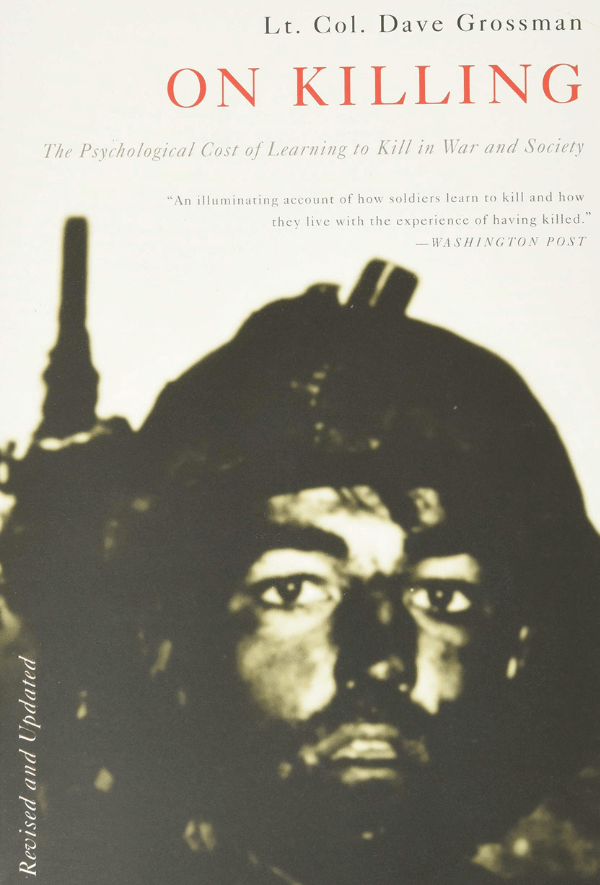
- Grossman,
D. (1995, 1996). On killing: The psychological cost of
learning to kill in war and society. New York: Little,
Brown, and Co.
-
Holmes, R. (1985). Acts of war: The behavior of men in
battle. New York: The Free Press.
-
Lorenz, K. (1966). On aggression. New York: Harcourt Brace.
-
Schwartz, B. & Robbins, S. J. (1995). Psychology of learning
and behavior (4th ed.). New York: W. W. Norton.
- Skinner,
B. F. (1938). The behavior of organisms: An experimental
analysis. New York: Appleton Century Crofts.
- Watson,
J. B. (1930, 1963) Behaviorism. Chicago: University of
Chicago.
©1999
by Academic Press. All rights of reproduction in any form
reserved.
|