|
The
Morality of Bombing:
Psychological Responses to "Distant Punishment"
by Lt. Col. Dave Grossman, USA (Ret)
With the 1921 publication of his book, Command of the
Air, Guilio Douhet became one of the world's first recognized
airpower adherents, claiming that the disintegration of
nations brought about by attrition in World War I would
be accomplished directly by aerial forces in the future.
Since then airpower advocates have repeatedly proclaimed
their ability to win wars solely through what has accurately
been termed "distant punishment." But Douhet had an
excuse that present day "air barons" do not: his belief
was based upon current scientific theory. That is, current
as of 80 years ago. A theory which has since been soundly
disproven and is no longer accepted by any scientific body.
The Origin of the Myth of Distant
Punishment
During World War I the probability of a soldier becoming
a psychiatric casualty was greater than that of being killed
by enemy fire. This was a new phenomenon in human history,
resulting from the manifestation of day-and-night combat
for months on end. When these hundreds-of-thousands of psychiatric
casualties began to occur in World War I, they were termed
"shell shock" and it was sincerely (and quite incorrectly)
believed by psychiatrists that these casualties were a result
of the physical impact of prolonged concussions on the brain.
At the end of World War I, psychiatrists and psychologists
believed that similar concussions, delivered by air and
inflicted on enemy troop concentrations and civilian populations
in cities, would result in similar mass psychiatric casualties.
As a result of this fallacy, air power adherents sincerely
envisioned vast numbers of "gibbering lunatics" being
driven from enemy cities by a rain of bombs.
The fields of psychiatry and psychology were truly "voodoo
sciences" during this period, far removed from the
scientific body of experimental-based, peer-reviewed, replicatable
data that has been so painfully established in the Post-World
War II era. And it was a tragically flawed but widely accepted
conclusion by the embryonic science of psychiatry that formed
the theoretical foundation for the German attempt to bomb
Britain into submission at the beginning of World War II
and the subsequent Allied attempt to do the same to Germany.
This unpredictable, uncontrollable reign of shock, horror,
and terror inflicted on civilian populations in World War
II is exactly what psychiatrists and psychologists believed
to be responsible for the vast numbers of psychiatric casualties
suffered by soldiers in World War I. And yet the Rand Corporation's
Strategic Bombing Study published in 1949 found that
there was only a very slight increase in the incidence of
psychological disorders in these populations as compared
to peacetime rates. In the words of historian Paul Fussell,
these post-World War II studies ascertained that: "German
military and industrial production seemed to increase just
like civilian determination not to surrender the more bombs
were dropped."
The Real Cause of Psychiatric Casualties
Today
the science of psychology knows that it is not fear of death
or injury that causes psychiatric casualties. Modern society
pursues fear through everything from roller coasters, to
action and horror movies, to rock climbing, and a hundred
other legal and illegal means. Fear itself is seldom a cause
of trauma in everyday peacetime existence, but facing close-range
interpersonal aggression is a traumatizing experience of
an entirely different magnitude.
The Diagnostic and Statistical Manual of the American Psychiatric
Association affirms that Post Traumatic Stress Disorder
(PTSD) "...may be especially severe or longer lasting when
the stressor is of human design." The DSM goes on to
note that PTSD resulting from natural disasters such as
tornadoes, floods, and hurricanes is comparatively rare
and mild, but acute cases of PTSD will consistently result
from torture or rape. Ultimately, like tornadoes, floods,
and hurricanes, bombs from 20,000 feet are simply not "personal"
and are significantly less traumatic -- to both the victim
and aggressor.
When snakes, heights, or darkness causes an intense fear
reaction in an individual it is considered a phobia, a dysfunction,
an abnormality. But it is very natural and normal to respond
to an attacking, aggressive fellow human being with a phobic-scale
response. This is a universal human phobia. More than anything
else in life, it is the potential for intentional, overt,
human confrontation that has the greatest ability to modify
and influence the behavior of human beings.
What this means to us today is that the entire body of psychology
and psychiatry, and the entire body of history in this field,
all affirm that a soldier, police officer, or peacekeeper
on the street is infinitely more effective at influencing
behavior than any quantity of impersonal bombs in the air,
no matter how "smart" those bombs may be. Anything
else is simply wishful thinking.
Psychologically,
aerial and artillery bombardments are effective, but only
in the front lines when they are combined with the threat
of the physical attack which usually follows such bombardments.
This is why there were massed psychiatric casualties following
World War I artillery bombardments, but World War II's strategic
bombing of population centers were surprisingly counter-productive
in breaking the enemy's will. Such bombardments without
an accompanying close-range assault, or at least the threat
of such an assault, are ineffective and may even serve no
other purpose than to inoculate the enemy and to stiffen
his will and resolve.
This is why inserting combat units in the enemy's rear is
infinitely more important and effective than even the most
comprehensive bombardments in his rear, or attrition along
his front. We saw this in the early years of the Korean
War when the rate of psychiatric casualties was almost seven
times higher than the average for World War II. Only after
the war settled down, lines stabilized, and the threat of
having enemy in rear areas decreased, did the average rate
go down to that of World War II. Again, just the potential
for close-up, inescapable, interpersonal confrontation is
more effective and has greater impact on human behavior
than the actual presence of inescapable, impersonal death
and destruction.
The
Death of a Myth
The lure of a sterile, distant, "clean" airpower victory
seems to be embedded in the human psyche. Many politicians,
and a certain breed of warrior, are deeply troubled by the
prospect of face-to-face confrontation. And, while they
want desperately to inflict their will upon their opponent,
they strive to find some way to do so without having to
physically confront that opponent, and without having to
personally witness the effects of their actions.
Thus
the myth of distant punishment fulfills a deep-seated need,
rooted in the avoidance of personal confrontation and a
need to deny the consequences of combat. And across the
generations airpower adherents have believed with all their
hearts, in spite of the overwhelming evidence to the contrary,
in the myth that they can just "wave the magic bombers and
make the bad man go away."
The innocent civilians they kill in this process they euphemistically
deny by simply terming them "collateral damage." And
the consistent history of the ineffectiveness of distant
punishment they simply choose to ignore, or to rationalize
by saying, "This time it will work because...our bombs are
more accurate...or more powerful." Or whatever. But
they refuse to acknowledge that, while the nature of weapons
may change, the basic nature of human beings does not change.
Human nature is one of the constants of warfare, and what
did not work before will not work now.
Our perennial airpower adherents base their calls for distant
punishment on a myth, which in turn is based on long-debunked
"scientific conclusions" that are close to a century
old--the equivalent of basing your space program on the
flat earth theory. Thus it is time to drive a stake through
the heart of this myth and bury it once and for all. The
basic concept is about as morally, scientifically, and politically
sound as claiming that you can police New York City with
cruise missiles.
Outside the trenches of denial among what is a small minority
even in the Air Force, there is no significant body of support
for the airpower adherents. Except in the recurrent wishful
thinking of politicians and the twisted, self-serving logic
of the aerospace industry, both of which are pandered to
quite shamelessly by the bomber lobby.
I would submit to you that using distant punishment to influence
a nation is like trying to get rid of the rats living in
an inhabited residence, without ever entering the building.
You can successfully influence the rats' behavior by burning
the house down (as we did in Dresden), or blowing the house
up (as we did in Hiroshima), or even by tossing in canisters
of nerve gas. But the human inhabitants of the building,
on whose behalf we are supposedly working, and the residents
of neighboring houses, all tend to strongly disapprove of
such strategies.
The obvious answer is to go into the building with our traps,
cats, ferrets, and rat terriers, and to clean up the filth
that the rats live in and on. But instead of doing this,
some among our military community are still too fastidious
to enter the building and confront the rats, and they have
come up with the bizarre idea of placing snipers at the
windows and periodically firing at the rats with shotguns
and high powered rifles. The fact that this strategy is
totally ineffective at controlling rats, and that it seriously
endangers the innocent residents of the building, is completely
inconsequential to the adherents of this distant punishment
strategy.
Immoral
and Soon to be Illegal?
It has been my pleasure in recent months to correspond extensively
with Dr. Robin Coupland, of the International Committee
of the Red Cross (ICRC), in Geneva, and editor of the ICRC
report on "The SIrUS Project." This is an extensive
body of research involving a database of over 26,000 war-wounded
patients at Red Cross hospitals around the world since 1991.
The objective of his work has been to determine which weapons
inflict what the Geneva Convention identifies as "superfluous
injury or unnecessary suffering." The upshot of this
research is that an extensive body of data now exists to
demonstrate what we all know: small arms fire kills or injures
comparatively few non-combatants, but instruments of "distant
punishment" (land mines, aerial bombing, and artillery)
are responsible for the vast majority of the indiscriminate
slaughter of non-combatants in war.
What I am telling you is that there is a tremendously influential
force at play in the world today which is determined to
see to it that artillery and aerial bombs will follow the
land mine down the endangered species path already trod
by gas warfare. It appears that those who propose to use
"distant punishment" as national policy will soon see
the day when they are considered as immoral international
criminals, little different from Saddam Hussein.
We cannot escape the fact that, whether we like it or not,
in the eyes of an increasingly large and influential body
of individuals in this post-Cold War era, those who advocate
distant punishment are really asking for license to kill
civilians, and tax dollars to do it with.
American GIs, as combatants or peacekeepers, in the streets
of a foreign nation have always been our best ambassadors,
and American bombers dropping impersonal death and destruction
from overhead have always been our worst. To have a national
policy that relies excessively on distant punishment is
to put our very worst foot forward.
There
can be little doubt that the execution of a policy based
on strategic bombing is likely to explode in our faces.
To explode figuratively, as CNN insures that we can no longer
deny the dead and wounded women and children that in the
past we have written off as "collateral damage." And then
to explode quite literally, as enraged nationalists are
inspired to return the favor of killing innocent women and
children through terrorist attacks along the line of the
Oklahoma City bombing--or, God forbid, with chemical, biological,
or nuclear weapons.
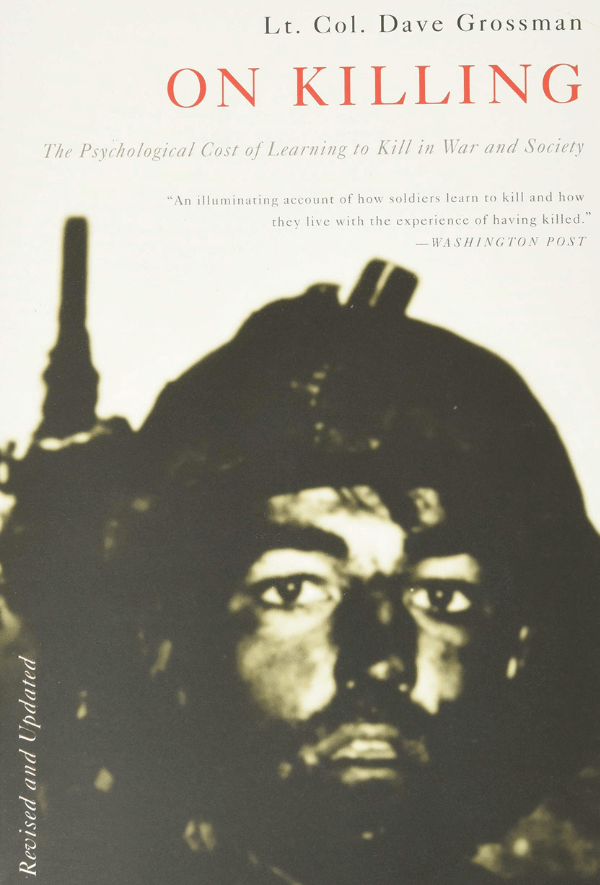
What I have presented here has also been presented in my
book, On Killing, which was nominated for a Pulitzer
prize and has been positively reviewed in over 100 periodicals
in over 30 nations. The implications of distant punishment
outlined here have also been integral to my entry on "Aggression
and Violence" in the Oxford Companion to American Military
History, and my entries on "The Psychological Effects
of Combat" and "The Evolution of Weaponry" in the Academic
Press Encyclopedia of Violence, Peace and Conflict,
all with extensive peer reviews and all without dissent.
I have lectured on this subject to 20 different colleges
and universities in the U.S. and Europe, and as the plenary
speaker to a British military historian's convention, as
well as conducting in-service training at the local, state,
and regional level to numerous psychiatric, psychological,
and mental health organizations. Again, this has all been
completely without dissent or controversy.
The bottom line is that, outside of a small cabal inside
the Air Force, and some self-serving members of the aerospace
industry, there is no intellectual, historical, or scientific
basis of support for distant punishment as national policy.
There
can be no doubt. There can be no denial. The irrefutable
truth is that, with very, very few exceptions, distant punishment
in the form of aerial bombing is: psychiatrically unsound,
psychologically impotent, strategically counterproductive,
morally bankrupt, and likely to soon be illegal.
Thus there is very little justification for basing national
policy on the effectiveness of air strikes. Or for directing
precious national resources toward conducting any air strike.
Unless it is in support of, and directed by, ground troops
who can and will psychologically exploit it. Ground troops
who will also have the moral courage to subsequently accept
direct personal and national responsibility for whatever
death and destruction results from that air strike. Nothing
else should be acceptable for a democratic nation in the
post-Cold War era.
Lt. Col. Dave Grossman
U.S. Army (Retired)
Director,
Warrior Science Group
Lt.
Col. Dave Grossman is a summa cum laude history graduate,
an Army Ranger, a British Army Staff College graduate, a
West Point Psychology Professor, and the author of the Pulitzer-nominated
book: On Killing: The Psychological Cost of Learning
to Kill in War and Society. On Killing, which
went into its 6th printing in 2001, has been critically
acclaimed in over 100 periodicals and journals in over 30
nations, and has been translated into Japanese and Italian.
Col. Grossman has been recognized as one of the world's
foremost experts in the field of human aggression and the
roots of violence and violent crime, and he has been called
upon to write the entry on "Aggression and Violence" in
the Oxford Companion to American Military History,
and three entries in the Academic Press Encyclopedia
of Violence, Peace and Conflict. Col. Grossman has also
served as an expert on human aggression in state and federal
courts, including UNITED STATES vs. TIMOTHY MCVEIGH. He
was also the lead trainer of mental health professionals
after the Jonesboro school shootings, where he also conducted
the initial inbriefing of the teachers on the morning after
the shootings. Col. Grossman has combined his experiences
and expertise to become the founder of a new field of scientific
endeavor, which he has termed "Killology." Since his retirement
from the U.S. Army in February 1998, Col. Grossman has been
called upon to serve as a speaker and trainer for numerous
military units, U.S. law enforcement agencies and associations,
medical associations and hospitals, and schools and educational
organizations.
|