|
"Psychological
Effects of Combat"
By
Dave Grossman and Bruce K. Siddle
Academic Press, 2000
THE
PSYCHOLOGICAL EFFECT OF COMBAT
is a concept which encompasses a wide variety of processes
and negative impacts, all of which must be taken into consideration
in any assessment of the immediate and long term costs of
war. This entry will address the wide-spectrum psychological
effects of combat, to include:
- Psychiatric
casualties suffered during combat
-
Physiological arousal and fear
-
The physiology of close combat
-
The price of killing
- Post-Traumatic
Stress Disorder (PTSD)
Introduction:
A Legacy of Lies
An
examination of the psychological effects of combat must
begin by acknowledging that there are some positive aspects
to combat. Throughout recorded history these positive aspects
have been emphasized and exaggerated in order to protect
the self-image of combatants, o honor the memory of the
fallen and rationalize their deaths, to aggrandize and glorify
political leaders and military commanders, and to manipulate
populations into supporting war and sending their sons to
their deaths. But the fact that these positive aspects have
been manipulated and exploited does not deny their existence.
There is a reason for the powerful attraction of combat
over the centuries, and there is no value in going from
the dysfunctional extreme of glorifying war to the equally
dysfunctional extreme of denying its attraction.
The
ability to recognize and confront danger, the powerful group
bonding that occurs in times of stress, the awe-inspiring
spectacle of a nation focused and aligned to achieve a single
aim, selfless dedication to abstract concepts and goals,
and the ability to overcome the powerful imperatives of
the survival instinct and willingly die for others: these
common aspects of war represent both important survival
traits and a potentially positive comment on basic human
nature. But if war does have a capacity for reflecting some
usually hidden, positive aspects of humanity, it irrefutably
does so at a great and tragic cost.
One
obvious and tragic price of war is the toll of death and
destruction. But there is an additional cost, a psychological
cost borne by the survivors of combat, and a full understanding
of this cost has been too long repressed by a legacy of
self-deception and intentional misrepresentation. After
peeling away this "legacy of lies" that has perpetuated
and glorified warfare there is no escaping the conclusion
that combat, and the killing that lies at the heart of combat,
is an extraordinarily traumatic and psychologically costly
endeavor that profoundly impacts all who participate in
it.
This
psychological cost of war is most readily observable and
measurable at the individual level. At the national level,
a country at war can anticipate a small -- but statistically
significant -- increase in the domestic murder rate, probably
due to the glorification of violence and the resultant reduction
in the level of "repression" of natural aggressive instincts
which Freud held to be essential to the existence of civilization.
At the group level, even the most elite unit is usually
psychologically destroyed when between 50 and 60% casualties
have been inflicted, and the integration of the individual
into the group is so strong that this destruction often
leads to depression and suicide. However, the nation (if
not eliminated by the war) is generally resilient, and the
group (if not destroyed) is inevitably disbanded. But the
individual who survives combat may well end up paying a
profound psychological cost for a lifetime. The cumulative
impact of these effects on hundreds of thousands of veterans
is pervasive, with significant potential to have a profound
effect on society at large.
Psychiatric
Casualties in War
Richard
Gabriel has noted that: "Nations customarily measure the
'costs of war' in dollars, lost production, or the number
of soldiers killed or wounded." But, "rarely do military
establishments attempt to measure the costs of war in terms
of individual suffering. Psychiatric breakdown remains one
of the most costly items of war when expressed in human
terms." Indeed, for the combatants in every major war fought
in this century, there has been a greater probability of
becoming a psychiatric casualty than of being killed by
enemy fire.
A psychiatric casualty is a combatant who is no longer able
to participate in combat due to mental (as opposed to physical)
debilitation. Psychiatric casualties seldom represent a
permanent debilitation, and with proper care they can be
rotated back into the line. (However, Israeli research has
demonstrated that, after combat, psychiatric casualties
are strongly predisposed toward the more long-term and more
permanently debilitating manifestation of Post-Traumatic
Stress Disorder.)
The
actual casualty can manifest itself in many ways, ranging
from affective disorders to somatoform disorders, but the
treatment for the many manifestations of combat stress involves
simply removing the soldier from the combat environment.
But the problem is that the military does not want to simply
return the psychiatric casualties to normal life, it wants
to return them to combat. And these casualties are understandably
reluctant to do so.
The evacuation syndrome is the paradox of combat psychiatry.
A nation must care for its psychiatric casualties, since
they are of no value on the battlefield (indeed, their presence
in combat can have a negative impact on the morale of other
combatants) and they can still be used again as valuable
seasoned replacements once they have recovered from combat
stress. But if combatants begin to realize that insane combatants
are being evacuated, the number of psychiatric casualties
will increase dramatically.
Continued "proximity" to the battlefield (through forward
treatment, usually within enemy artillery range) combined
with an "expectancy" of rapid return to combat, are the
principles developed to overcome the paradox of the evacuation
syndrome. These principles of proximity and expectancy have
proven themselves quite effective since World War I. They
permit the psychiatric casualty to get the rest that is
the only current cure for his problem, while not giving
a message to still healthy comrades that insanity is a ticket
away from the madness of the battlefield.
But even with the careful application of the principles
of proximity and expectancy the incidence of psychiatric
casualties is still enormous. During World War II, 504,000
men were lost from America's combat forces due to psychiatric
collapse--enough to man 50 divisions. The United States
suffered this loss despite efforts to weed out those mentally
and emotionally unfit for combat by classifying more than
800,000 men 4-F (unfit for military service) due to psychiatric
reasons. At one point in World War II, psychiatric casualties
were being discharged from the U.S. Army faster than new
recruits were being drafted in.
Swank and Marchand's World War II study of US Army combatants
on the beaches of Normandy found that after 60 days of continuous
combat, 98% of the surviving soldiers had become psychiatric
casualties. And the remaining 2% were identified as "aggressive
psychopathic personalities." Thus it is not too far from
the mark to observe that there is something about continuous,
inescapable combat which will drive 98% of all men insane,
and the other 2% were crazy when they got there. Figure
1 presents a schematic representation of the effects of
continuous combat.
It must be understood that the kind of continuous, protracted
combat that produces such high psychiatric casualty rates
is largely a product of 20th-century warfare. The Battle
of Waterloo lasted only a day. Gettysburg lasted only three
days--and they took the nights off. It was only in World
War I that armies began to experience months of 24-hour
combat, and it is in World War I that vast numbers of psychiatric
casualties were first observed.
The democratic nations of this century have been better
than most at admitting and dealing with their combat psychiatric
casualties, and information from non-Western sources is
extremely limited, but we now know that America's World
War II experience is representative of a universal cost
of modern, protracted warfare. Armies around the world have
experienced similar mass psychiatric casualties, but many
have simply driven these casualties into battle at bayonet
point, shooting those who refused or were unable to continue.
Japanese units in World War II employed a unique set of
powerful cultural and group processes to delay psychiatric
breakdown, but they only succeeded in temporarily delaying
the cost of combat, a cost that eventually manifested itself
in mass suicide. Ultimately the toll of modern combat is
truly fearful, and no nation or culture has been able to
escape it.

Physiological
Arousal and Fear
The
soldier in combat endures many indignities. Among these
can be endless months and years of exposure to desert heat,
sweltering jungle, torrential rains, or frozen mountains
and tundras. Usually the soldier lives amidst swarming vermin.
Very often there is lack of food, lack of sleep, and the
constant uncertainty that eats away at the combatants' sense
of control over their lives and their environment. But,
bad as they are, all of these stressors can be found in
many cultural, geographic, or social circumstances, and
when the ingredient of war is removed individuals exposed
to these circumstances do not suffer mass psychiatric casualties.
To fully comprehend the intensity of the stress of combat,
we must keep these other stressors in mind while understanding
the body's physiological response to combat, as manifested
in the sympathetic nervous system's mobilization of resources.
And then we must understand the impact of the parasympathetic
nervous system "backlash" that occurs as a result of the
demands placed upon it. The sympathetic nervous system (SNS)
mobilizes and directs the body's energy resources for action.
It is the physiological equivalent of the body's front-line
soldiers who actually do the fighting in a military unit.
The parasympathetic nervous system is responsible for the
body's digestive and recuperative processes. It is the physiological
equivalent of the body's cooks, mechanics, and clerks who
sustain a military unit over an extended period of time.
Usually the body maintains itself in a state of homeostasis,
which ensures that these two nervous systems maintain a
balance between their demands upon the body's resources.
But during extremely stressful circumstances the "fight-or-flight"
response kicks in and the SNS mobilizes all available energy
for survival. This is the physiological equivalent of throwing
the cooks, mechanics, and clerks into the battle. This process
is so intense that soldiers very often suffer stress diarrhea
due to redirecting of energies from nonessential parasympathetic
processes, and it is not at all uncommon to lose control
of urination and defecation as the body literally 'blows
its ballast" and redirects all available energy in an attempt
to provide the resources required to ensure survival. This
is reflected in World War II surveys in which a quarter
of combat veterans admitted that they urinated in their
pants in combat, and a quarter admitted that they defecated
in their pants in combat.
A combatant must pay a physiological price for an enervating
process so intense. The "price" that the body pays is an
equally powerful "backlash" when the neglected demands of
the parasympathetic nervous system become ascendant. This
parasympathetic backlash occurs as soon as the danger and
the excitement is over, and it takes the form of an incredibly
powerful weariness and sleepiness on the part of the soldier.
Napoleon stated that the moment of greatest danger was the
instant immediately after victory, and in saying so he demonstrated
a powerful understanding of the way in which soldiers become
physiologically and psychologically incapacitated by the
parasympathetic backlash that occurs as soon as the momentum
of the attack has halted and the soldier briefly believes
himself to be safe. During this period of vulnerability
a counterattack by fresh troops can have an effect completely
out of proportion to the number of troops attacking.
It is basically for this reason that the maintenance of
an "unblown" reserve has historically been essential in
combat, with battles often revolving around which side can
hold out and deploy their reserves last. Clausewitz understood
the danger of reserve forces becoming prematurely enervated
and exhausted (and he provides insight into the root cause
of the enervation) when he cautioned that the reserves should
always be maintained out of sight of the battle.
In continuous combat the soldier roller-coasters through
a seemingly endless series of these surges of adrenaline
and their subsequent backlashes, and the body's natural,
useful, and appropriate response to danger ultimately becomes
extremely counterproductive. Unable to flee, and unable
to overcome the danger through a brief burst of fighting,
posturing, or submission, the bodies of modern soldiers
in sustained combat exhaust their capacity to enervate.
They slide into a state of profound physical and emotional
exhaustion of such a magnitude that it appears to be almost
impossible to communicate it to those who have not experienced
it.
Most observers of combat lump the impact of this physiological
arousal process under the general heading of 'fear," but
fear is really a cognitive or emotional label for nonspecific
physiological arousal in response to a threat. The impact
of fear and its attendant physiological arousal is significant,
but it must be understood that fear is just a symptom and
not the disease, it is an effect but not the cause. To truly
understand the psychological effects of combat, we must
understand exactly what it is that causes this intense fear
response in individuals. It has become increasingly clear
that there are two key, core stressors causing the psychological
toll associated with combat. These stressors are: the trauma
associated with being the victim of close-range, interpersonal
aggression; and the trauma associated with the responsibility
to kill a fellow human being at close range.
The
Trauma of Close-Range, Interpersonal Aggression
During World War II the carnage and destruction caused by
months of continuous German bombing in England, and years
of Allied bombing in Germany, was systematically inflicted
in order to create psychological casualties among civilian
populations. Day and night, in an intentionally unpredictable
pattern, civilians, relatives and friends were mutilated,
killed and their homes were destroyed. These civilian populations
suffered fear and horror of a magnitude that few humans
will ever experience.
This
unpredictable, uncontrollable reign of shock, horror, and
terror is exactly what psychiatrists and psychologists prior
to World War II believed to be responsible for the vast
numbers of psychiatric casualties suffered by soldiers in
World War I. And yet, incredibly, the Rand Corporation's
Strategic Bombing Study published in 1949 found that there
was only a very slight increase in the psychological disorders
in these populations as compared to peacetime rates and
that these occurred primarily among individuals already
predisposed to psychiatric illness. These bombings, which
were intended to break the will of the population, appear
to have served primarily to harden the hearts and increase
the determination to fight among those who endured them.
The
impact of fear, physiological arousal, horror, and physical
deprivation in combat should never be underestimated, but
it has become clear that other factors are responsible for
psychiatric casualties among combatants. One of those factors
is the impact of close-range, interpersonal, aggressive
confrontation.
Through
roller-coasters, action and horror movies, drugs, rock climbing,
whitewater rafting, scuba diving, parachuting, hunting,
contact sports, and a hundred other means, modern society
pursues fear. Fear in and of itself is seldom a cause of
trauma in everyday peacetime existence, but facing close-range
interpersonal aggression and hatred from fellow citizens
is a horrifying experience of an entirely different magnitude.
The ultimate fear and horror in most modern lives is to
be raped, tortured, or beaten, to be physically degraded
in front of loved ones or to have the sanctity of the home
invaded by aggressive and hateful intruders. The Diagnostic
and Statistical Manual of the American Psychiatric Association
affirms this when it notes that Post-Traumatic Stress Disorder
(PTSD) . . . may be especially severe or longer lasting
when the stressor is of human "design." PTSD resulting
from natural disasters such as tornadoes, floods, and hurricanes
is comparatively rare and mild, but acute cases of PTSD
will consistently result from torture or rape. Ultimately,
like tornadoes, floods, and hurricanes, bombs from 20,000
feet are simply not "personal" and are significantly less
traumatic to both the victim and aggressor.
Death
or debilitation is statistically far more likely to occur
by disease or accident than by malicious action, but statistics
have nothing to do with fear. Statistically speaking, cigarette
smoking is an extraordinarily dangerous activity that annually
inflicts slow, hideous deaths upon millions of individuals
worldwide, but this fact does not dissuade millions of individuals
from smoking, and around the globe few nations are motivated
to pass laws to protect their citizens from this threat.
But the presence of one serial rapist in a large city can
change the behavior of hundreds of thousands of individuals,
and there is a broad tradition of laws designed to protect
citizens from rape, assault, and murder.
When snakes, heights, or darkness cause an intense fear
reaction in an individual it is considered a phobia, a dysfunction,
an abnormality. But it is very natural and normal to respond
to an attacking, aggressive fellow human being with a phobic-scale
response. This is a universal human phobia. More than anything
else in life, it is intentional, overt human hostility and
aggression that assaults the self-image, sense of control
and ultimately, the mental and physical health of human
beings.
The soldier in combat is inserted straight into the inescapable
midst of this most psychologically traumatic of environments.
Ultimately, if the combatant is unable get some respite
from the trauma of combat, and if not injured or killed,
the only escape available is the psychological escape of
becoming a psychiatric casualty and mentally fleeing the
battlefield.
The
Physiology of Close Combat
An understanding of the stress of close combat begins with
an understanding of the physiological response to close-range
interpersonal aggression. The traditional view of combat
stress is most often associated with combat fatigue and
Post-Traumatic Stress Disorder, which are actually manifestations
that occur after, and as a result of, combat stress. Bruce
Siddle has defined combat stress as the perception of an
imminent threat of serious personal injury or death, or
when tasked with the responsibility to protect another party
from imminent serious injury or death, under conditions
where response time is minimal.
The
debilitating effects of combat stress have been recognized
for centuries. Phenomenon such as tunnel vision, auditory
exclusion, the loss of fine and complex motor control, irrational
behavior, and the inability to think clearly have all been
observed as byproducts of combat stress. Even though these
phenomena have been observed and documented for hundreds
of years, very little research has been conducted to understand
why combat stress deteriorates performance.
The key characteristic which distinguishes combat stress
is the activation of the SNS. The SNS is activated when
the brain perceives a threat to survival, resulting in a
immediate discharge of stress hormones. This "mass discharge"
is designed to prepare the body for fight-or-flight. The
response is characterized by increasing arterial pressure
and blood flow to large muscle mass (resulting in increased
strength capabilities and enhanced gross motor skills--such
as running from or charging into an opponent), vasoconstriction
of minor blood vessels at the end of appendages (which serves
to reduce bleeding from wounds), pupil dilation, cessation
of digestive processes, and muscle tremors. Figure 2 (below)
presents a schematic representation of the effects of hormone
induced heart rate increase resulting from SNS activation.
The
activation of the SNS is automatic and virtually uncontrollable.
It is a reflex triggered by the perception of a threat.
Once initiated, the SNS will dominate all voluntary and
involuntary systems until the perceived threat has been
eliminated or escaped, performance deteriorates, or the
parasympathetic nervous system activates to reestablish
homeostasis.
The degree of SNS activation centers around the level of
perceived threat. For example, low-level SNS activation
may result from the anticipation of combat. This is especially
common with police officers or soldiers minutes before they
make a tactical assault into a potential deadly force environment.
Under these conditions combatants will generally experience
increases in heart rates and respiration, muscle tremors,
and a psychological sense of anxiety.
In
contrast, high-level SNS activation occurs when combatants
are confronted with an unanticipated deadly force threat
and the time to respond is minimal. Under these conditions
the extreme effects of the SNS will cause catastrophic failure
of the visual, cognitive, and motor control systems. Although
there are endless variables that may trigger the SNS, there
are six key variables that have an immediate impact of the
level of SNS activation. These are the degree of malevolent,
human intent behind the threat; the perceived level of threat,
ranging from risk of injury to the potential for death;
the time available to response; the level of confidence
in personal skills and training; the level of experience
in dealing with the specific threat; and the degree of physical
fatigue that is combined with the anxiety.
Once
activated, the SNS causes immediate physiological changes,
of which the most noticeable and easily monitored is increased
heart rate. SNS activation will drive the heart rate from
an average of 70 beats per minute (BPM) to more than 200
BPM in less than a second. As combat stress increases, heart
rate and respiration will increase until catastrophic failure,
or until the parasympathetic nervous system is triggered.
In 1950, S.L.A. Marshall's The Soldier's Load and the Mobility
of a Nation was one of the first studies to identify how
combat performance deteriorates when soldiers are exposed
to combat stress. Marshall concluded that we must reject
the superstition that under danger men can be expected to
have more than their normal powers, and that they will outdo
their best efforts simply because their lives are in danger.
Indeed, in many ways, the reality is just the opposite and
individuals under stress are far less capable of doing anything
other than blindly running from or charging toward a threat.
Humans have three primary survival systems: vision, cognitive
processing, and motor skill performance. Under stress, all
three break down.
Bruce K. Siddle's landmark research at PPCT involved monitoring
the heart rate responses of law enforcement officers in
interpersonal conflict simulations using paintball-type
simulation weapons. This research has consistently recorded
heart rate increases to well over 200 beats per minute,
with some peak heart rates of up to 300 beats per minute.
These were simulations in which the combatants knew that
their life was not in danger. The combatant, in a true life-and-death
situation (whether soldier or law enforcement officer),
faces the ultimate universal human phobia of interpersonal
aggression and will certainly experience a physiological
reaction even greater than that of Siddle's subjects. The
fundamental truth of modern combat is that the stress of
facing close-range interpersonal aggression is so great
that, if endured for months on end without any other means
of respite or escape, the combatant will inevitably become
a psychiatric casualty.
Even greater than the resistance to being the victim of
close-range aggression is the combatant's powerful aversion
to inflicting aggression on fellow human beings. At the
heart of this dread is the average healthy person's resistance
to killing one's own kind.
A
Resistance to Killing
The
kind of psychiatric casualties usually identified with long-term
exposure to combat are notably reduced among medical personnel,
chaplains, officers, and soldiers on reconnaissance patrols
behind enemy lines. The key factor that is not present in
each of these situations is that, although they are in the
front lines and the enemy may attempt to kill them, they
have no direct responsibility to participate personally
in close-range killing activities. Even when there is equal
or even greater danger of dying, combat is much less stressful
if you do not have to kill.
The existence of a resistance to killing lies at the heart
of this dichotomy between killers and nonkillers. This is
an additional, final stressor that the combatant must face.
To truly understand the nature of this resistance of killing
we must first recognize that most participants in close
combat are literally "frightened out of their wits." Once
the bullets start flying, combatants stop thinking with
the forebrain, which is the part of the brain which makes
us human, and start thinking with the midbrain, or mammalian
brain, which is the primitive part of the brain that is
generally indistinguishable from that of an animal.
In
conflict situations this primitive, midbrain processing
can be observed in the existence of a powerful resistance
to killing one's own kind. During territorial and mating
battles, animals with antlers and horns slam together in
a relatively harmless head-to-head fashion, rattlesnakes
wrestle each other, and piranha fight their own kind with
flicks of the tail, but against any other species these
creatures unleash their horns, fangs, and teeth without
restraint. This is an essential survival mechanism that
prevents a species from destroying itself during territorial
and mating rituals.
One
major modern revelation in the field of military psychology
is the observation that this resistance to killing one's
own species is also a key factor in human combat. Brigadier
General S.L.A. Marshall first observed this during his work
as the official US historian of the European Theater of
Operations in World War II. Based on his post-combat interviews,
Marshall concluded in his landmark book, Men Against Fire,
that only 15 to 20% of the individual riflemen in World
War II fired their weapons at an exposed enemy soldier.
Specialized weapons, such as a flame-thrower, usually were
fired. Crew-served weapons, such as a machine gun, almost
always were fired. And firing would increase greatly if
a nearby leader demanded that the soldier fire. But, when
left to their own devices, the great majority of individual
combatants throughout history appear to have been unable
or unwilling to kill.
Marshall's findings have been somewhat controversial. Faced
with scholarly concern about a researcher's methodology
and conclusions, the scientific method involves replicating
the research. In Marshall's case, every available, parallel,
scholarly study validates his basic findings. Ardant du
Picq's surveys of French officers in the 1860s and his observations
on ancient battles, Keegan and Holmes' numerous accounts
of ineffectual firing throughout history, Richard Holmes'
assessment of Argentine firing rates in the Falklands War,
Paddy Griffith's data on the extraordinarily low killing
rate among Napoleonic and American Civil War regiments,
the British Army's laser reenactments of historical battles,
the FBI's studies of nonfiring rates among law enforcement
officers in the 1950s and 1960s, and countless other individual
and anecdotal observations all confirm Marshall's fundamental
conclusion that man is not, by nature, a killer.
The exception to this resistance can be observed in sociopaths
who, by definition, feel no empathy or remorse for their
fellow human beings. Pit bull dogs have been selectively
bred in order to ensure that they will perform the unnatural
act of killing another dog in battle. Similarly, human sociopaths
represent Swank and Marchand's 2% who did not become psychiatric
casualties after months of continuous combat, since they
were not disturbed by the requirement to kill. But sociopaths
would be a flawed tool that is impossible to control in
peacetime, and social dynamics make it very difficult for
humans to breed themselves for such a trait. However, humans
are very adept at finding mechanical means to overcome natural
limitations. Humans were born without the physical ability
to fly, so we found mechanisms that overcame this limitation
and enabled flight. Humans also were born without the psychological
ability to kill our fellow humans. So, throughout history,
we have devoted great effort to finding a way to overcome
this resistance. From a psychological perspective, the history
of warfare can be viewed as a series of successively more
effective tactical and mechanical mechanisms to enable or
force combatants to overcome their resistance to killing.
Overcoming
the Resistance to Killing
By 1946 the US Army had accepted Marshall's conclusions,
and the Human Resources Research Office of the US Army subsequently
pioneered a revolution in combat training that eventually
replaced firing at bullseye targets with deeply ingrained
"conditioning" using realistic, man-shaped, pop-up targets
that fall when hit. Psychologists know that this kind of
powerful "operant conditioning" is the only technique that
will reliably influence the primitive, midbrain processing
of a frightened human being, just as fire drills condition
terrified school children to respond properly during a fire,
and repetitious, "stimulus-response" conditioning in
flight simulators enables frightened pilots to respond reflexively
to emergency situations.
Throughout
history the ingredients of groups, leadership, and distance
have been manipulated to enable and force combatants to
kill, but the introduction of conditioning in modern training
was a true revolution. The application and perfection of
these basic conditioning techniques increased the rate of
fire from near 20% in World War II to approximately 55%
in Korea and around 95% in Vietnam. Similar high rates of
fire resulting from modern conditioning techniques can be
seen in FBI data on law enforcement firing rates since the
nationwide introduction of modern conditioning techniques
in the late 1960s. Figure 3 presents a schematic representation
of the interaction between the killing enabling factors
that have been manipulated throughout history, including
the key, modern ingredient of conditioning.
One of the most dramatic examples of the value and power
of this modern, psychological revolution in training can
be seen in Richard Holmes' observations of the 1982 Falklands
War. The superbly trained (i.e., "conditioned") British
forces were without air or artillery superiority and consistently
outnumbered three-to-one while attacking the poorly trained
but well-equipped and carefully dug-in Argentine defenders.
Superior British firing rates (which Holmes estimates to
be well over 90%), resulting from modern training techniques,
has been credited as a key factor in the series of British
victories in that brief but bloody war. Any future army
that attempts to go into battle without similar psychological
preparation is likely to meet a fate similar to that of
the Argentines.

The
Price of Overcoming The Resistance to Killing
The
extraordinarily high firing rate resulting from modern conditioning
processes was a key factor in America's ability to claim
that US ground forces never lost a major engagement in Vietnam.
But conditioning that overrides such a powerful, innate
resistance carries with it enormous potential for psychological
backlash. Every warrior society has a "purification ritual"
to help returning warriors deal with their "blood guilt"
and to reassure them that what they did in combat was "good."
Features of the ritual are a "group therapy" session
and a ceremony embracing the veteran back into the tribe.
Modern Western rituals traditionally involve long periods
while marching or sailing home, parades, monuments, and
the unconditional acceptance from society and family.
Table I outlines some of the key factors in the killing
experience rationalization and acceptance processes, using
the example of US troops in Vietnam as a case study of an
extreme circumstance in which the purification rituals broke
down. For example, combatants do not do what they do in
combat for medals, they are motivated largely by a concern
for their comrades, but after the battle medals serve as
a kind of "Get Out of Jail Free Card": a powerful talisman
that proclaims to them and to others that what the combatant
did was honorable and acceptable. Although medals were issued
after Vietnam, the social environment was such that veterans
could not wear the medals or their uniforms in public. Similarly,
the young combatant needs the presence of mature, older
comrades to seek guidance and support from, but in Vietnam, especially in the peak years of the war, the average
age of the combatant was probably less than during any other war in US
history. Other key factors unique to the American
experience in Vietnam include the absence of any truly safe,
secure area in-country. Also, the individual replacement
system that hampered bonding and ensured that soldiers often
arrived and left as strangers. The use of aircraft to immediately
return veterans to America, without the usual cool-down,
group therapy period, which has been experienced for thousands
of years as veterans sailed or marched home.
TABLE
1
Killing
Experience Rationalization and Acceptance
Processes
A
Comparative Study
|
Process
|
Past
Wars |
Vietnam
|
| Praise from peers and superiors
(medals, citations) |
Yes
|
Yes (not worn)
|
| The presence of mature, older comrades |
Yes
|
No (Reduced)
|
| Circumstances limiting civilian kills/atrocities |
Yes
|
No (Reduced)
|
| Rear lines and safe areas |
Yes
|
No
|
| Presence of close, trusted friends throughout
the war |
Yes
|
No
|
| Cool-down period with comrades while
returning home |
Yes
|
No
|
| Knowledge of victory, gain and accomplishments |
Yes
|
No
|
| Parades and monuments |
Yes
|
No (Delayed)
|
| Reunions and continued commo with comrades
after the war |
Yes
|
No
|
| Acceptance and praise from friends,
family, and society |
Yes
|
No (Mixed)
|
| Support to veteran from religious and
political systems |
Yes
|
No (Mixed)
|
For
America's Vietnam veterans the purification ritual was largely
denied, and a host of studies have demonstrated that one
of the the most significant causal factors in Post-Traumatic
Stress Disorder is the lack of support structure after the
traumatic event, which in this case occurred when the returning
veteran was attacked and condemned in an unprecedented manner.
The traditional horrors of combat were magnified by modern
conditioning techniques, combining the nature of the war
with an unprecedented degree of societal condemnation. This
created a circumstance of Post-Traumatic Stress Disorder
(PTSD) among the 3.5 million US veterans of Southeast Asia.
Estimations are between 0.5 and 1.5 million cases, although
the results of these studies vary greatly. This mass incidence
of psychiatric disorders among Vietnam veterans resulted
in the "discovery" of PTSD, a condition that we now
know has always occurred as a result of warfare, but never
before in this quantity. Armies around the world have integrated
these lessons from Vietnam, and in Britain's Falklands War,
Israel's 1982 Lebanon incursion, and in the U.S.'s Gulf
War the lessons of Vietnam and the need for the purification
ritual have been closely and carefully considered and applied.
In the former U.S.S.R.'s Afghanistan War this need was again
ignored, and the resulting social turmoil was a one of the
factors that eventually led to the collapse of that nation.
Indeed, the Weinberger Doctrine, later referred to as the
Powell Doctrine, which holds that the United States will
not engage in a war without strong societal support, is
a reflection of the tragic lessons learned from the psychological
effects of combat in Vietnam.
PTSD is a psychological disorder resulting from a traumatic
event. PTSD manifests itself in persistent re-experiencing
of the traumatic event, numbing of emotional responsiveness,
and persistent symptoms of increased arousal, resulting
in clinically significant distress or impairment in social
and occupational functioning. There is often a long delay
between the traumatic event and the manifestation of PTSD.
Among Vietnam veterans in the United States, PTSD has been
strongly linked with greatly increased divorce rates, increased
incidence of alcohol and drug abuse, and increased suicide
rates. Indeed, Veterans Administration data indicate that,
as of 1996, three times more Vietnam veterans have died
from suicide after the war than died from enemy action during
the war, and this number is increasing every year.
But PTSD seldom results in violent criminal acts, and US
Bureau of Justice Statistics research indicates that veterans,
including Vietnam veterans, are statistically less likely
to be incarcerated than a nonveteran of the same age. The
key safeguard in this process appears to be the deeply ingrained
discipline which the soldier internalizes with military
training. However, with the advent of interactive "point-and-shoot"
arcade and video games there is significant concern that
society is aping military conditioning, but without the
vital safeguard of discipline. There is strong evidence
to indicate that the indiscriminate civilian application
of combat conditioning techniques as entertainment may be
a key factor in worldwide, skyrocketing violent crime rates,
including a sevenfold increase in per capita aggravated
assaults in America since 1956. Thus, the psychological
effects of combat can increasingly be observed on the streets
of nations around the world.
Conclusion:
A Cultural Conspiracy
It is essential to acknowledge that good ends have been
and will continue to be accomplished through combat. Many
democracies owe their very existence to successful combat.
Few individuals will deny the need for combat against Nazi
Germany and Imperial Japan in World War II. And around the
world the price of civilization is paid every day by military
units on peacekeeping operations and domestic police forces
who are forced to engage in close combat. There have been
and will continue to be times and places where combat is
unavoidable, but when a society requires its police and
armed forces to participate in combat it is essential to
fully comprehend the magnitude of the inevitable psychological
toll.
It is often said that "All's fair in love and war," and
this expression provides a valuable insight into the human
psyche, since these twin, taboo fields of sexuality and
aggression represent the two realms in which most individuals
will consistently deceive both themselves and others. Our
psychological and societal inability to confront the truth
about the effects of combat is the foundation for the cultural
conspiracy of repression, a deception and denial that has
helped to perpetuate and propagate war throughout recorded
history.
In the field of developmental psychology a mature adult
is sometimes defined as someone who has attained a degree
of insight and self-control in the two areas of sexuality
and aggression. This is also a useful definition of maturity
in civilizations. Thus two important and reassuring trends
in recent years have been the development of the science
of human sexuality, which has been termed "sexology," and
a parallel development of the science of human aggression,
which D. Grossman has termed "killology." There is universal
consensus that continued research in this previously taboo
realm of human aggression is vital to the future development,
and perhaps to the very existence, of our civilization.
Glossary
of Terms....."Psychological Effects of Combat"
- Evacuation
Syndrome:
The paradox of combat psychiatry. Psychiatric casualties
must be treated, but if soldiers begin to realize that
psychiatric casualties are being evacuated, the number
of psychiatric casualties will increase dramatically.
- Fear:
A cognitive or emotional label for nonspecific physiological
arousal in response to a threat.
- Midbrain:
Sometimes referred to as the mammalian brain, it is the
primitive part of the brain that is generally indistinguishable
from that of any other mammal. During times of extreme
stress cognition tends to localize in this portion of
the brain.
- Operant
Conditioning:
Training that prepares an organism to react to a specific
stimulus with a specific voluntary motor response. Operant
conditioning is highly effective in preparing individuals
to respond with desired actions in highly stressful circumstances.
- Parasympathetic
Nervous System:
The branch of the autonomic nervous system that is responsible
for the body's digestive and recuperative processes.
- Post-Traumatic
Stress Disorder (PTSD):
A psychological disorder resulting from a traumatic event.
PTSD manifests itself in persistent re-experiencing of
the traumatic event, numbing of emotional responsiveness,
and persistent symptoms of increased arousal, resulting
in clinically significant distress or impairment in social
and occupational functioning. There is often a long delay
time between the traumatic event and the manifestation
of PTSD. PTSD has been strongly linked with greatly increased
divorce rates, increased suicide rates, and increased
incidence of alcohol and drug abuse.
- Psychiatric
Casualty:
A combatant who is no longer able to participate in combat
due to mental (as opposed to physical) debilitation.
- Purification
Ritual:
A set of symbolic social mechanisms that help returning
veterans to come to terms with their actions in combat
and successfully integrate back into peacetime society.
- Sympathetic
Nervous System (SNS):
The branch of the autonomic nervous system that mobilizes
and directs the body's energy resources for action.
Bibliography
..... "Psychological Effects of Combat"
-
Gabriel, R. A. (1987). No more Heroes: Madness and
psychiatry in war. New York: Hill and Wang.
-
Greene, B. (1989). Homecoming. New York: G. P.
Putnam's Sons.
-
Griffith, P. (1989). Battle tactics of the (American)
civil war. London.
- Grossman,
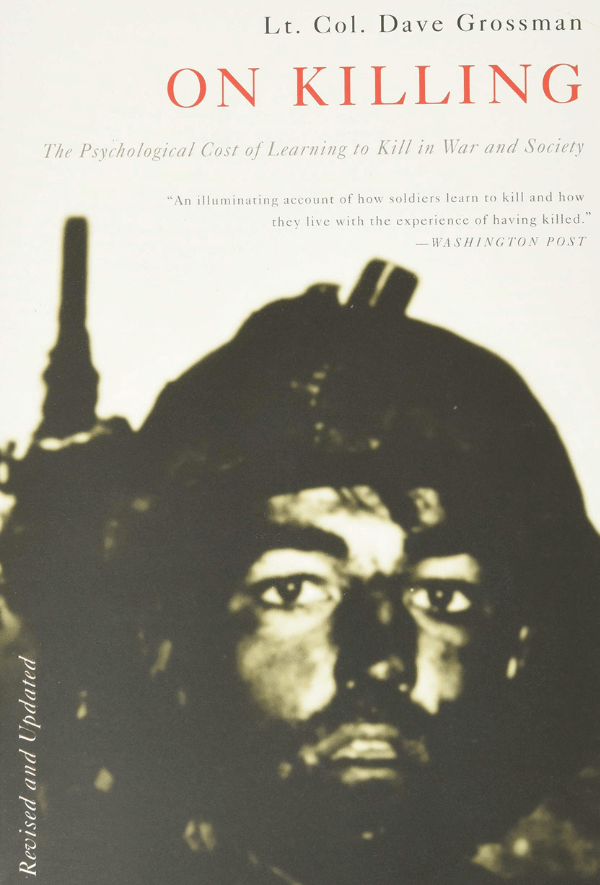
D. (1995, 1996). On killing: The psychological cost
of learning to kill in war and society. New York:
Little, Brown, and Co.
-
Holmes, R. (1985). Acts of war: the behavior of men
in battle. New York: The Free Press.
-
Keegan, J. (1976). The face of battle. Harmondsworth,
England: The Chaucer Press.
- Keegan,
J., & Holmes, R. (1985). Soldiers. London: Hamish
Hamilton.
- Marshal,
S. LA. (1978). Men against fire. Gloucester, MA:
Peter Smith.
- Siddle,
B. K. (1995). Sharpening the warrior's edge: The psychology
and science of training. Millstadt, IL: PPCT Management
Systems.
- Swank,
R. L., & Marchand, W. E. (1946). Combat neuroses: development
of combat exhaustion. Archives of Neurology and Psychology,
55, 236-247.
©1999
by Academic Press. All rights of reproduction in any form
reserved.
|